MDF vs Plywood: Which to Use for Cabinets and Built-Ins
Plywood belongs in the cabinet box more often. MDF earns its place under paint. The smart custom job uses each material where it does its best work.
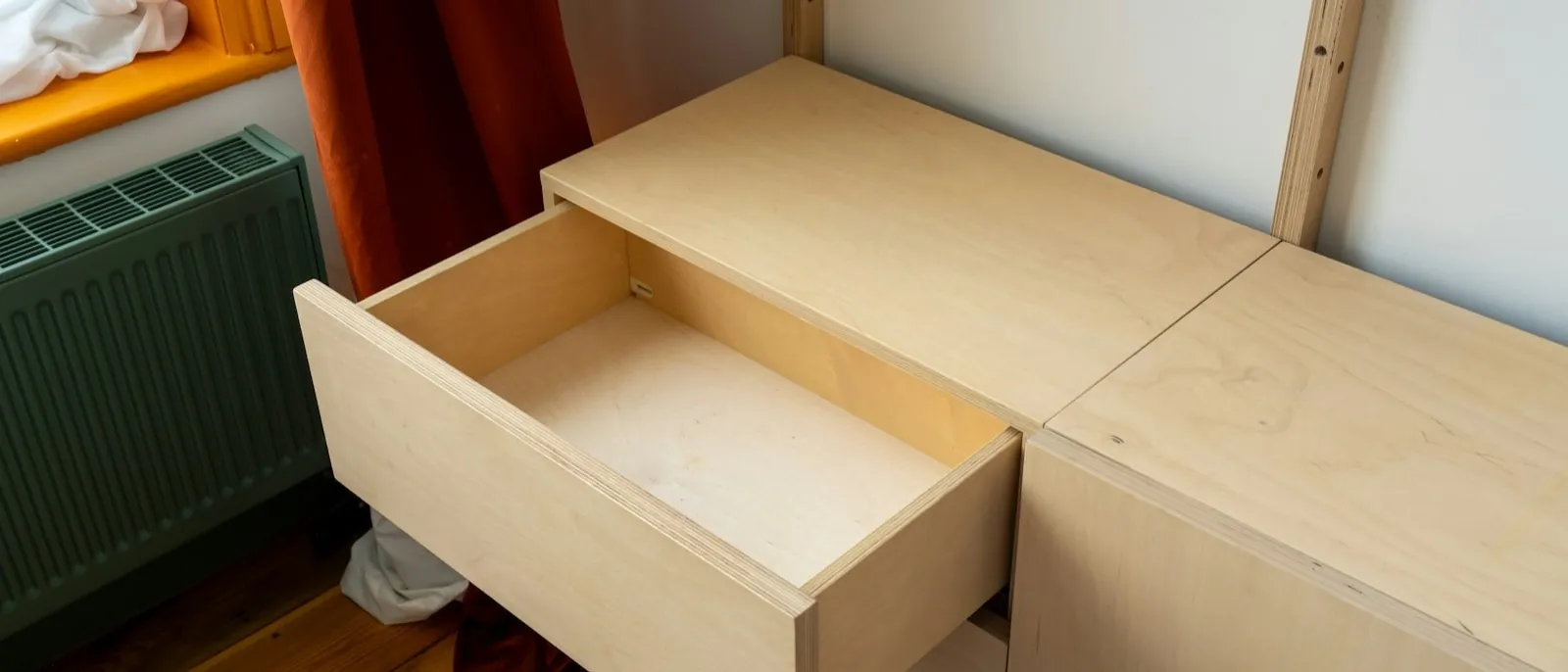
The quote says “wood cabinets.”
It sounds reassuring. It also tells you almost nothing.
Your box could be veneer-core plywood. Your painted door could be MDF. Your finished end might be hardwood plywood with a maple face. And a panel sold as hardwood plywood can hide an MDF or particleboard core beneath the veneer.
You don't need one material to win the whole cabinet.
Here is the useful decision: which material belongs in your box, door, shelf, finished end, and that damp corner under the sink?
MDF vs plywood: the short answer
For most custom cabinet jobs, you start here:
| Cabinet part or condition | Better starting choice | Why |
|---|---|---|
| Kitchen or built-in cabinet boxes | Veneer-core plywood | Lower weight, good stiffness, durable fastening near edges, and more forgiving behavior after brief wetting |
| Painted slab or routed doors | MDF | Smooth face, homogeneous core, and clean machining under an opaque finish |
| Stained doors and visible ends | Veneered plywood or solid wood | Real grain remains visible through a clear or stained finish |
| Long or heavily loaded shelves | Plywood, often with a reinforced front edge | Better stiffness-to-weight starting point; the final span still depends on load and construction |
| Sink base, vanity, laundry, or mudroom base | Specified moisture-resistant construction, usually plywood at the vulnerable box parts | Neither panel survives neglect, so material, edge sealing, base detail, and leak access work together |
| Decorative painted end panels and trim shapes | MDF | Flat surface and crisp profiles reduce finish preparation |
That table gives you a starting choice. It doesn't specify a cabinet.
The Architectural Woodwork Institute publishes tested casework configurations using MDF, veneer core, and particleboard. A capable shop can build strong cabinets from more than one panel type. The panel name doesn't tell you the joinery, back construction, hardware, edging, finish, or installation quality.
What MDF and plywood actually are
The MDF in your quote is medium-density fiberboard. Wood is reduced to fibers, combined with resin and other additives, formed into a mat, and pressed into a dense, uniform panel.
And that uniformity is the whole point.
There are no veneer voids and no grain direction at the face. Your shop can route the same profile again and again, while your paint lies over a smooth surface without wood grain showing through.
Plywood is built from layers of veneer. The USDA Wood Handbook explains that adjacent layers run with their grain directions perpendicular to one another. That cross-lamination gives the panel useful strength and stiffness in both directions and reduces splitting near an edge.
Now, watch the wording trap.
“Hardwood plywood” describes the face and product class, not always an all-veneer interior. The USDA and EPA's composite-wood definition both recognize hardwood plywood made with veneer, lumber, particleboard, MDF, hardboard, or combination cores. If your quote stops at “hardwood plywood,” it stops too soon.
Ask one more question: Is it veneer-core plywood?
Plywood cabinets: where plywood earns its place
Plywood earns its keep in the parts that carry your cabinet, hold hardware, or take rough service.
Cabinet boxes
Your cabinet box has to stay square while it carries shelves, drawers, doors, a countertop, and the occasional person leaning on the front edge. Then your box has to survive delivery, shimming, fastening, and a house that isn't perfectly level.
Veneer-core plywood gives your shop a strong, relatively light panel for sides, bottoms, partitions, backs, and hanging strips. The USDA notes that plywood's alternating grain direction reduces splitting when fasteners sit near panel edges, a useful property in cabinet construction.
But the plywood label alone proves very little. Core voids, thin face veneers, warped sheets, poor edging, and the wrong grade can turn an impressive-sounding material into an ordinary box.
Make the shop identify the face veneer, veneer-core construction, nominal thickness, exposed-edge treatment, and finished interior. If the answer is only “cabinet-grade plywood,” keep asking.
Shelves
Plywood is usually the better starting material for your long shelf or one carrying dense dishes, books, records, or pantry goods. You get more stiffness for the weight than with standard MDF, and a solid wood front edge can add stiffness while protecting the exposed edge.
Beware the magic shelf-width rule. There isn't one that works for every job. Your load, depth, thickness, material, fixed or adjustable support, and front-edge construction all matter.
Our built-in bookshelves guide owns the shelf-span and built-in construction detail. Use it to size the bay and reinforcement instead of asking a material label to do an engineer's job.
Stained and clear-finished work
Plywood can wear a decorative wood veneer, letting your shop match a white oak, walnut, maple, or cherry face across cabinet ends and broad panels. The visible layer is real wood. Now the stain has something worth showing.
Make your quote name the species, veneer cut, leaf match, grain direction, core, and edge treatment. “Stained plywood” leaves every visible decision open.
MDF cabinets: where MDF earns its place
MDF gets dismissed as the cheap substitute in far too much cabinet advice.
That's lazy thinking.
Give MDF the right job in your design and it can be the better material.
Painted doors and drawer fronts
Standard MDF has a smooth face and a homogeneous core. Weyerhaeuser's technical description identifies it for routed and machined applications where a smooth, homogeneous finish is required.
That gives you a strong substrate for painted slab doors, routed one-piece doors, drawer fronts, applied panels, and decorative shapes. There is no grain to telegraph through your paint, and the router meets the same material through the full profile.
This use also lines up with the Architectural Woodwork Institute's panel standard. AWI permits MDF in panel construction and says veneer core shouldn't be used for cabinet door or drawer-front components.
Your finish still has work to do. Your machined MDF edges need the primer, sanding, topcoat, and coverage specified for that system. A smooth raw panel won't rescue a thin or poorly cured paint film.
Painted end panels and built-in details
MDF stays flat and machines cleanly. That's useful when your painted finished ends, valances, applied molding, shallow arches, and repeated trim profiles need to look crisp.
Keep those parts out of standing water and away from unsealed floor contact. If your painted panel runs to the floor beside a tub, washer, exterior door, or sink, your base detail matters every bit as much as the face finish.
Full MDF cabinet boxes
An MDF box can be engineered to perform. AWI's tested construction library includes MDF casework, which is a useful correction to the claim that every MDF cabinet is weak.
But you pay attention to the tradeoffs: weight, edge damage, fastener strategy, and moisture risk. For your custom home project, full MDF boxes need a clear reason, a tested construction method, and a quote that identifies the joinery and base protection.
If your shop means MDF doors on plywood boxes, that's a very different cabinet. Get the distinction in writing.
Painted vs stained cabinets
Paint and stain ask opposite things from the substrate.
Paint wants a flat, consistent surface. MDF gives it one. It's especially useful for broad slab fronts and routed profiles where a uniform face matters more than visible grain.
Stain wants figure, color, and grain. Use hardwood veneer or solid wood on the exposed surface. MDF can sit beneath a real wood veneer, but raw MDF itself has no natural grain to reveal.
For a painted Shaker door, your shop may use solid wood rails and stiles around an MDF center panel, or machine the whole profile from MDF. Those constructions behave differently at the edges, joints, repairs, and around moisture. Make sure the drawing tells you which one you're buying.
For your stained Shaker door, solid wood frames and a veneered center panel are the usual logic. Broad panel products handle the flat field while solid wood gives your frame durable edges and visible grain.
Wet rooms and sink cabinets
Plywood handles a brief wetting event more forgivingly than standard MDF. The USDA reports minimal irreversible thickness swelling in plywood after wetting, while wax in fiberboard only slows liquid-water pickup for a limited time.
Read this carefully: that does not make plywood waterproof.
Most decorative hardwood plywood is made for interior or protected service. Standard MDF is also an interior product. Even moisture-resistant fiberboard is described by its manufacturer as not waterproof and not intended for wet-area use.
If your sink base, bath vanity, laundry cabinet, mudroom, or built-in touches a slab, specify the vulnerable parts instead of hoping your finish will save them:
- Veneer-core plywood at the box bottom, sides, and base where leaks are most likely
- Sealed cut edges and penetrations
- A finished or removable sink-base floor that lets you see and clean a leak
- Moisture-resistant base components where the design calls for them
- Clear separation from standing water and wet flooring
- Access to shutoffs, traps, supply lines, and appliance connections
AWI's current architectural casework standard (ANSI/AWI 0641-2019) gives a useful benchmark: when a moisture-resistant base is specified, its material must test at 5 percent thickness swell or less under ASTM D1037. Put the requirement in the quote and ask the shop to identify the compliant material.
No panel survives a leak nobody fixes.
Weight, fasteners, and installation
MDF is heavy.
And that matters long before your cabinet reaches the wall.
Weyerhaeuser's standard MDF data lists a density of 48.5 pounds per cubic foot for panels thicker than 0.551 inch. A nominal 3/4-inch 4-by-8 panel contains 2 cubic feet, which puts that representative sheet at about 97 pounds.
Columbia Forest Products' hardwood plywood guide says its veneer-core panels typically weigh about 70 pounds per 3/4-inch panel.
Those are representative products, not universal weights. The species and core you choose, along with face, moisture content, and actual thickness, change the number. But the practical difference is real: a full MDF box or a large MDF door gives your installer and your hardware more mass to control.
The fasteners in your cabinet depend on more than the panel name. Screw type, pilot hole, edge distance, thread engagement, joint design, and repeated adjustment all matter.
Plywood's cross-laminated veneers resist splitting near edges. MDF has a uniform core, but a screw driven carelessly into an edge can break out material. Ask how your box joints are made, where your wall-hanging fasteners land, and what supports your large door. Don't settle for “we use plenty of screws.”
MDF vs plywood for built-ins
Your built-ins often need both materials.
Use plywood where your case carries shelves, bridges an opening, anchors to the room, or takes abuse at a base. Use MDF where your painted face panel, valance, arch, or trim profile needs to stay smooth.
Then design the shelf as a system. A plywood shelf with a weak edge and an ambitious span can sag. An MDF shelf with a stiff front edge, fixed support, and a short bay may perform well. Your drawing has to show the material, thickness, edge, support, and expected load.
How your built-in meets the room matters too. Scribes, fillers, crown, base, and wall anchorage make a row of separate cases read as one built-in. The built-in bookshelves guide covers those construction details and the quote questions that go with them.
What about solid wood?
Solid wood belongs where its grain, edge, repairability, and feel earn the cost in your project: face frames, door frames, edging, trim, moldings, and selected shelves or tops.
But don't assume it is automatically the best material for your broad flat panel. The USDA Wood Handbook explains that solid wood changes dimension as its moisture content changes, and the movement differs across and along the grain. Your wide solid panel needs joinery that allows that movement.
Plywood and MDF make broad panels more predictable. Your custom cabinet can use solid wood at the durable visible edges, veneer-core plywood in the structure, and MDF beneath paint.
That's a material schedule, not a compromise.
How the material choice moves a custom quote
The sheet price is only one line.
Plywood can raise your material allowance, especially when your job specifies an all-veneer core, a premium face, matched grain, prefinished interiors, clean exposed edges, or a high ply count. It can also reduce your installed weight and give your shop a strong structural panel.
MDF can lower your panel cost and reduce surface preparation on painted work. It can also add handling weight, require careful edge finishing, and change your hardware or construction for a large door.
Now for the part your raw price comparison misses: shop workflow.
Your builder may be set up to spray routed MDF doors efficiently. Another shop may buy five-piece doors from a specialist and build every box from prefinished plywood. The cheaper raw sheet doesn't always produce the cheaper installed cabinet for you.
Ask your bidders for the material decision as a price delta:
- What changes if the boxes move from the quoted core to veneer-core plywood?
- Which parts are MDF: doors only, finished ends, shelves, or the full box?
- What face veneer, core, thickness, and bond class are included in the plywood?
- Which edges are solid wood, edge-banded, filled, or left visible?
- What material is used under the sink and at every floor-contacting base?
- Does the finish price include priming and sealing every machined MDF edge?
- Do large doors or shelves change the hardware, reinforcement, or warranty?
- Are delivery, installation, scribing, touch-up, and adjustment included?
Our custom cabinet cost guide explains how material, finish, hardware, design time, installation, and site conditions move the full bid. Use it beside this material list so every shop prices the same cabinet.
What to put in the quote
Give each bidder the same drawings and require a component schedule:
| Component | Material details the quote should state |
|---|---|
| Box sides, tops, bottoms, and partitions | Panel type, core, face, thickness, interior finish, and exposed-edge treatment |
| Backs and hanging strips | Material, thickness, capture method, anchorage, and wall-fastener path |
| Fixed and adjustable shelves | Material, thickness, clear span, front edge, support, and intended load |
| Doors and drawer fronts | Construction, core or frame material, thickness, edge profile, finish, and size limits |
| Finished ends and applied panels | Substrate, face or veneer, edge treatment, grain direction, and finish |
| Sink, vanity, laundry, and mudroom bases | Moisture-resistant material, sealed penetrations, floor contact, and leak access |
| Drawer boxes | Side, bottom, joint, slide, and finish specification |
| Compliance | TSCA Title VI labeling for regulated composite wood products |
The AWI submittal standard follows the same logic: identify exposed, semi-exposed, and concealed materials, plus door cores, edges, drawer construction, hinges, and shelf hardware.
If the quote can name every visible finish but not the cabinet box core, it isn't ready to sign.
Formaldehyde and indoor-air questions
Your MDF and hardwood plywood can both contain adhesive systems that emit formaldehyde. Don't let anyone turn your indoor-air question into an MDF-only question.
The EPA regulates hardwood plywood, MDF, and particleboard under TSCA Title VI. Regulated panels and finished goods sold in the United States must carry the required compliance labeling.
Ask the shop to confirm TSCA Title VI compliance for the panels and finished cabinetry. If lower-emitting or no-added-formaldehyde materials matter to your project, put that requirement in the specification and ask for the product documentation before fabrication.
Questions people actually ask
Is MDF or plywood better for cabinets?
Plywood is the better starting choice for cabinet boxes, shelves, and wet-risk locations. MDF is often better for painted doors, routed profiles, drawer fronts, and decorative panels. A strong custom cabinet commonly uses both.
Are plywood cabinets always better quality?
No. Core quality, thickness, joinery, back construction, edges, hardware, finish, and installation still control the result. Some hardwood plywood also has an MDF or particleboard core, so ask whether the box material is veneer-core plywood.
Are MDF cabinets bad?
No. MDF is smooth, uniform, and well suited to painted or machined parts. Full MDF boxes bring more weight and moisture risk, so the shop should explain the joinery, fasteners, base protection, hardware, and reason for using it.
Is MDF waterproof if it is moisture resistant?
No. Moisture-resistant MDF is designed to reduce swelling compared with standard MDF, but manufacturers still describe it as an interior product, not waterproof. It needs sealed edges, protected installation, and prompt leak repair.
Is plywood waterproof?
Not automatically. Most decorative hardwood plywood is intended for interior or protected use. Plywood generally recovers from brief wetting better than standard MDF, but the bond class, core, edges, finish, and exposure still have to match the job.
Which material is better for painted cabinet doors?
MDF is a strong choice because its face and core are uniform, it machines cleanly, and it has no grain to show through paint. Solid wood frames with an MDF center panel are another common construction. The shop should state the door design and how every edge and machined profile is finished.
Which material is better for stained cabinets?
Use a visible hardwood veneer or solid wood where the grain will show. Veneer-core plywood works well for broad stained panels and cabinet ends. Solid wood is useful for frames, edging, trim, and parts that take wear.
Is MDF heavier than plywood?
Usually. One representative technical comparison puts a nominal 3/4-inch 4-by-8 MDF panel around 97 pounds and a veneer-core hardwood plywood panel around 70 pounds. Actual weight changes with the product, species, core, moisture, and thickness.
Where these comparisons come from
Panel definitions, cross-lamination, plywood fastening behavior, moisture recovery, and general use come from the USDA Forest Products Laboratory's Wood Handbook chapters on composite materials and mechanical properties.
Cabinet material, door-core, moisture-resistant base, and component-schedule guidance comes from the Architectural Woodwork Institute's standards for panel products, architectural wood casework, and submittals.
Representative weight data comes from Weyerhaeuser's standard MDF specification and Columbia Forest Products' hardwood plywood guide. Those examples don't set a universal panel weight.
Federal emissions and labeling guidance comes from the US EPA's TSCA Title VI consumer FAQ.