White Oak Cabinets: The Complete Guide
The cut, the finish, and the premium: including the one decision that determines whether your white oak kitchen still looks like white oak in ten years.
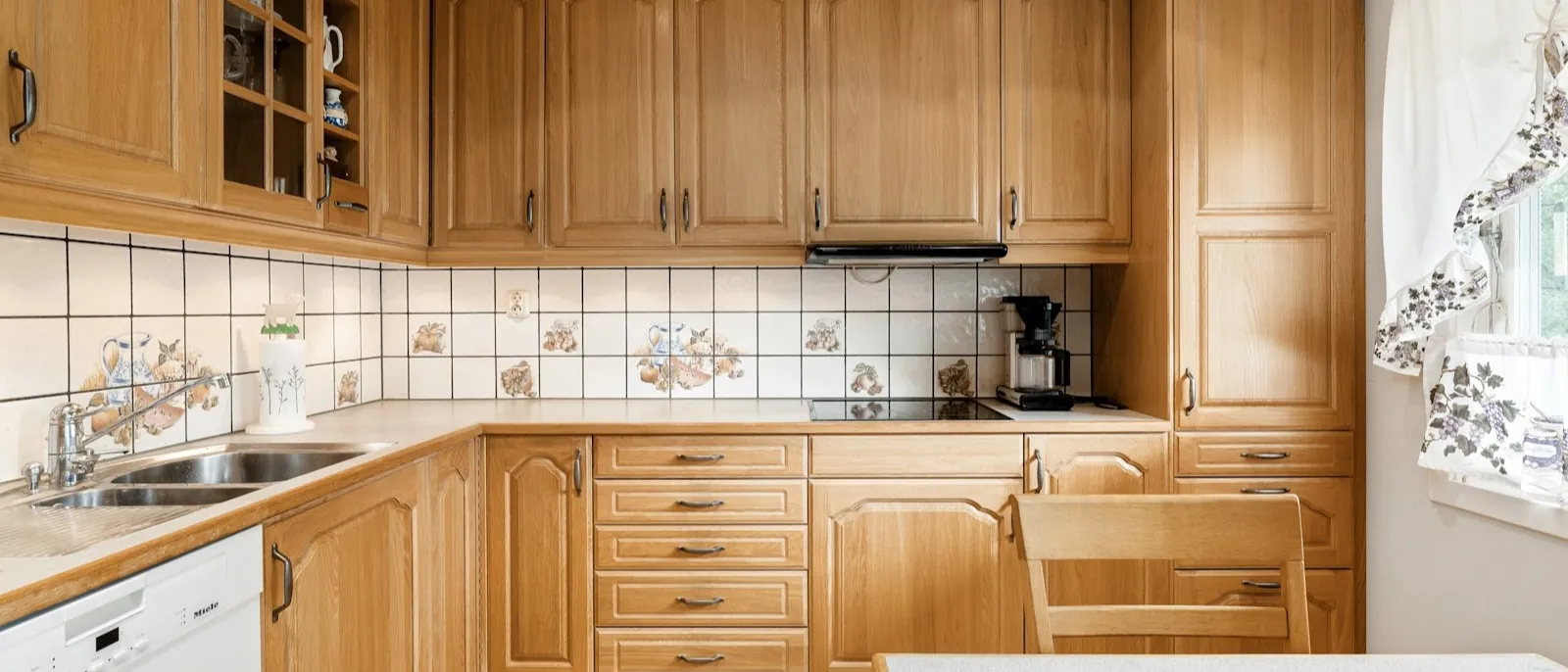
White oak has been the default answer to "what wood?" in American kitchens for about a decade now. But if you're specifying it, you need to know why rift sawn costs more than plain sawn and which finish quietly turns it orange.
The cut determines the grain you see and drives the price you pay. The topcoat decides whether your kitchen is still pale in ten years.
The cut is the look
White oak comes off the same tree three ways. The difference between them is more visible in your kitchen than the difference between most wood species.
| Cut | Grain | Stability | Relative cost |
|---|---|---|---|
| Plain sawn (flat sawn) | Wide cathedral arches, strong color variation between high and low grain | Standard | Most affordable |
| Quarter sawn | Straight grain plus pronounced medullary ray fleck | More stable: resists cupping and warping | Higher |
| Rift sawn | Tight, perfectly linear vertical grain; minimal fleck or ray | Very stable | Typically the highest |
The reason rift and quarter cost more isn't craftsmanship mystique. It's arithmetic. Both are cut at an angle across the log rather than straight through it, which produces more offcut and less usable board per tree.
You're paying for the wood that got thrown away.
How to choose: if you want the calm, uniform, almost-linen look that modern kitchens are built on, rift sawn is what you're actually picturing. If you want visible character and don't mind flecking, quarter sawn gives you figure for less money. Plain sawn is the budget choice, and on a Shaker door with a busy cathedral grain it can look restless across a long run of cabinets.
The finish decides whether it stays white oak
White oak doesn't yellow. Finishes yellow.
Oil-based and other solvent-based clear coats contain resins that oxidize with exposure to light and air. Over several years they develop a warm amber cast that deepens continuously.
On cherry that reads as richness. On the pale white oak in your kitchen, it reads as orange.
Two finishes hold the color:
- Water-based clear coat (polyurethane or varnish). No ambering resin. Keeps the wood's true tone and is the standard recommendation for white oak, ash, maple, and anything grey or white-washed.
- Hardwax oil: the Rubio Monocoat and Osmo category. Penetrates and cures inside the wood rather than sitting on top, leaving a low-sheen matte surface with real grain texture underfoot and underhand. Keeps the color true and repairs spot-by-spot rather than requiring a full refinish.
Hardwax oil repairs spot by spot and feels like wood. Water-based film finishes stand up better to standing water and grease.
Around your sink or range, use the film finish. On your island or a run of doors, either works.
If your shop quotes white oak with an oil-based topcoat and doesn't raise ambering, ask directly what your doors will look like in five years.
Is it hard enough?
Yes, and by a comfortable margin. White oak rates 1,360 lbf on the Janka scale, which measures the force needed to embed a steel ball halfway into the wood.
That puts it above cherry and walnut for dent resistance and well into the range where normal abuse in your kitchen doesn't leave marks.
Stability is the second half of durability, and here the cut matters again. Quarter sawn white oak moves less with seasonal humidity than plain sawn, which makes it the safer specification for your wide doors, tall panels, and any house with dramatic winter-to-summer swings.
What it costs
White oak carries roughly a 15 to 25 percent premium over a painted baseline. For context, here's where that sits against the other common upgrades:
| Species or upgrade | Premium over painted baseline |
|---|---|
| Stained maple or cherry | +10 – 15% |
| White oak | +15 – 25% |
| Walnut | +30 – 50% |
| Inset doors (any species) | +20 – 30% |
| Hand-rubbed or oil finish | +10 – 15% |
Then the cut adds its own layer on top: plain sawn cheapest, quarter sawn more, rift sawn typically the most.
Red oak is meaningfully less expensive than white oak right now. But under a light finish it reads pink, with an open, coarse grain that resists every attempt to make your kitchen look modern.
Here's what that premium does to a real quote. A 22-linear-foot white oak Shaker kitchen quoted by a Tennessee shop in 2026 came to $28,440 installed: about $1,293 per linear foot.
You can see that quote broken down line by line in our custom cabinet cost guide.
Five things to specify, in writing
- The cut: rift, quarter, or plain. "White oak" alone isn't a specification.
- Grain direction on drawer fronts: vertical or horizontal, and whether a bank of drawers is grain-matched as a set.
- The topcoat chemistry: water-based, hardwax oil, or solvent-based, and whether the shop has samples that have been in daylight for a year.
- Veneer or solid on the flat panels. Rift-sawn veneer over a stable core is a legitimate, often superior choice for wide panels; it isn't a downgrade, but you should know which you're buying.
- Interior finish: whether cabinet interiors are finished white oak, a matched melamine, or raw.
Questions people actually ask
What's the difference between rift sawn and quarter sawn white oak?
Both are cut across the log rather than through it, and both cost more than plain sawn because they waste more of the tree. Rift sawn produces a tight, perfectly linear vertical grain with almost no flecking: the quiet, uniform look most modern kitchens are after. Quarter sawn produces that same straight grain plus the distinctive medullary ray fleck, a flashy figure people either love or specifically avoid. Rift is generally the more expensive of the two because it demands the most labor and yields the least usable wood per log.
Do white oak cabinets turn yellow over time?
The wood doesn't, but the finish can. Oil-based and other solvent-based clear coats contain resins that oxidize and amber over the years, which is what turns a cool white oak kitchen progressively orange. Water-based clear coats and natural hardwax oils don't carry that resin, so they hold the wood's true color. If keeping white oak light is the point of choosing it, the finish decision matters more than the cut.
How much more do white oak cabinets cost?
Expect roughly 15 to 25 percent above a painted baseline, compared with 10 to 15 percent for stained maple or cherry and 30 to 50 percent for walnut. Within white oak, the cut adds another layer: plain sawn is the most affordable, quarter sawn costs more, and rift sawn typically costs the most because it wastes the most material.
Is white oak durable enough for a kitchen?
Yes. White oak rates 1,360 lbf on the Janka hardness scale, which measures resistance to denting: comfortably harder than cherry or walnut and among the more dent-resistant cabinet woods in common use. Quarter sawn white oak also moves less with humidity than plain sawn, making it the more stable choice for wide doors and panels.
What's the difference between white oak and red oak cabinets?
Despite the names, the practical difference is tone and grain rather than color. White oak reads cooler and browner with a tighter, less porous grain; red oak reads pinker with an open, coarse grain that's hard to disguise under a light finish. Red oak is also noticeably less expensive right now. If a light modern look is the goal, white oak gets there and red oak fights you the whole way.
Where these numbers come from
Sawing methods, relative costs, and Janka hardness from Wood & Co., Cabinetdoors.com, and Xpress Cabinet Doors; finish and ambering behavior from Ask a Cabinetmaker and Fine Woodworking; species premiums and the itemized quote from Spring Hill Design & Woodcraft. Premiums vary by shop and region. Treat them as a starting point.