Shaker Cabinets, Explained
Why a door style invented by a religious sect that banned ornament is still the most-ordered kitchen in America, and the three details that separate custom Shaker from catalog Shaker.
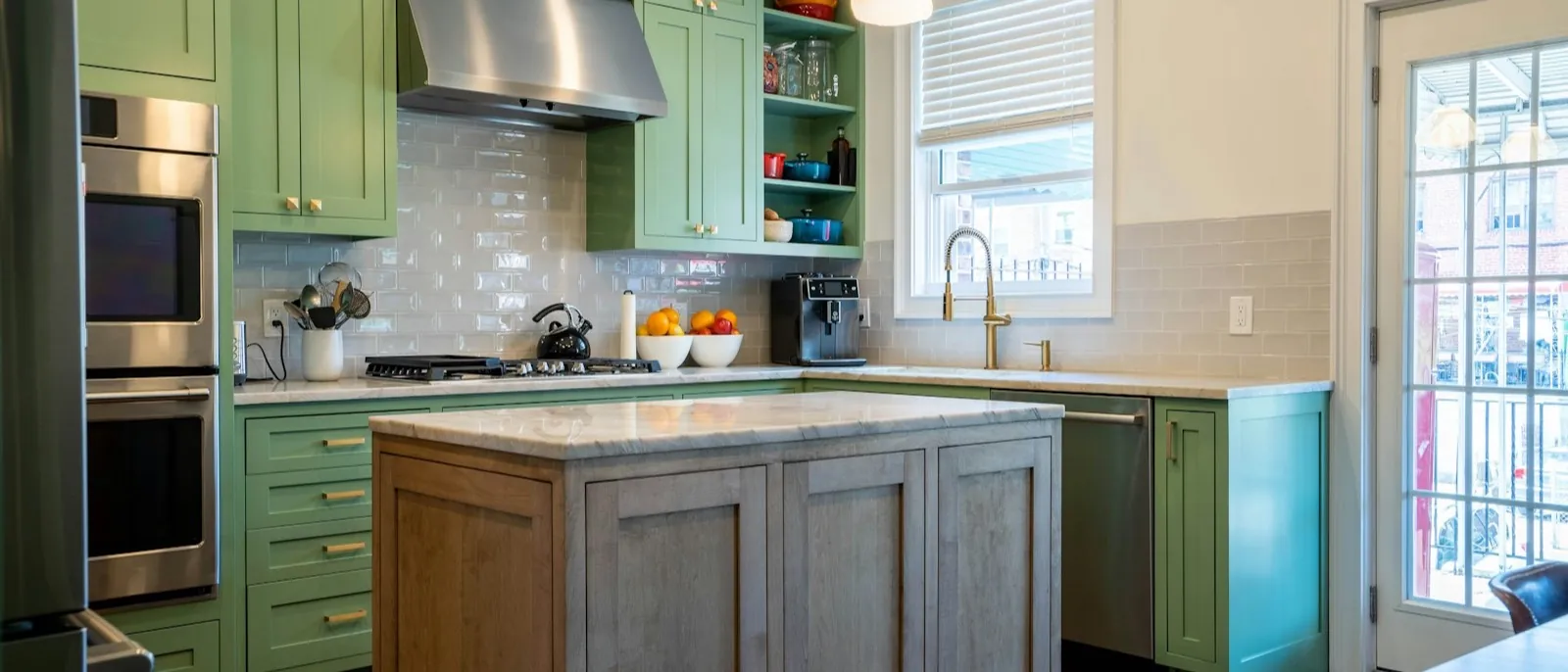
The Shakers banned decoration on religious grounds. No carving, no molding, no flourish that did not do a job.
What they were left with was joinery and proportion. They got so good at both that two centuries later their door is still the one most Americans order.
And that creates a problem for you. When every cabinet line from the home center to the high-end shop sells "Shaker," the word stops telling you anything. Here's what actually varies.
What makes a door Shaker
When you order a Shaker door, you're ordering five pieces: two vertical stiles, two horizontal rails, and a flat center panel recessed roughly a quarter inch below the face of the frame. That's the whole vocabulary. No raised field, no applied molding, no ogee.
Underneath, the construction is equally plain. A typical shop cuts a centered quarter-inch groove, three-eighths to a half inch deep, into the inside edges of all four frame pieces.
The panel floats in that groove, not glued, so it can expand and contract with the seasons without splitting the frame.
That floating panel is why your Shaker doors survive humidity swings that split glued-up slab doors.
Detail one: rail and stile width
Standard Shaker frames run 2¼" to 3½" wide. The right number depends on the door in front of you.
| Door width | Frame width that looks right |
|---|---|
| 12" – 18" | 2¼" – 2½" |
| Wider fronts | 2¾" or more, to hold visual weight |
Stock lines pick one frame width and run it across every door in your kitchen, because tooling changes cost money at volume.
On a 12" door a 3" frame leaves a panel barely 6" wide. On a 30" door the same frame looks thin. You see the mismatch as soon as the doors hang side by side.
A custom shop sizes the frame to your door. That's most of what the premium buys.
Detail two: inset or overlay
Where your door sits relative to the cabinet face is the biggest single driver of both look and price.
| Full overlay | Inset | |
|---|---|---|
| Position | Sits outside the face frame, covering it | Sits flush inside the frame |
| Sizing | Add about ½" total to width and height | Subtract 1/16" – 1/8"; reveal around 3/32" |
| Look | Contemporary, continuous, minimal gaps | Traditional, furniture-like, visible frame |
| Cost | Most popular, least expensive | +20 – 30% |
Inset costs more for a reason worth understanding: a 3/32" reveal has to stay a 3/32" reveal in February and in August, on a door that's made of wood, in a house whose humidity swings forty percent.
Your shop needs better material selection, tighter tolerances, and hinges that can be adjusted. It's a genuine craft premium, not a markup.
If your shop offers inset at the same price as overlay, ask what the reveal spec is and what happens if it moves.
Detail three: what the door is made of
If your Shaker doors will be painted, MDF outperforms solid wood.
Two reasons. MDF's uniform density means no grain telegraphing, no wood texture ghosting up through the paint film on your doors as the finish ages.
And because MDF doesn't expand and contract along a grain direction, it doesn't open the hairline cracks that appear at the rail-and-stile joints of painted solid wood doors, usually in year two or three, always at the same four corners.
Solid wood is the right answer for stained doors, holds more resale value, and is what you want if the grain is part of your design.
But choosing solid wood for a painted kitchen because it sounds more premium is the most common expensive mistake in this whole category.
If you're stained rather than painted, the species conversation starts in our white oak guide: Shaker's flat frame shows off straight grain better than almost any other door style.
What Shaker costs
| Version | Per linear foot |
|---|---|
| Stock Shaker, uninstalled | from ~$100 |
| Stock Shaker, installed | $100 – $400 |
| MDF | $150 – $300 |
| Maple | $250 – $400 |
| Fully custom, solid wood | $500 – $1,500 |
Then your finish adds another charge on top: painted Shaker doors add roughly 10 to 20 percent, and painted solid wood specifically adds 15 to 35 percent over the same door stained.
Paint is more labor (more prep, more coats, less forgiveness), and that's where your money goes.
For how these tiers behave across a whole kitchen, see custom vs. semi-custom vs. stock.
Four questions that separate the good quote from the cheap one
- Are rail and stile widths sized per door, or is one width used throughout?
- Is the center panel floating in a groove, or glued in? Glued panels split.
- For painted work: MDF or solid wood frames? And if solid wood, what happens at the joints in year three?
- Overlay or inset, and what's the reveal spec?
Get those four in writing before you sign anything.
Questions people actually ask
What's a Shaker cabinet door?
A five-piece door: two vertical stiles, two horizontal rails, and a flat recessed center panel that sits about a quarter inch below the frame face. No raised profile, no applied molding, no bevel. The style comes from 19th-century Shaker furniture, where ornament was a moral problem and the joinery had to carry the whole design. That constraint is exactly why it still looks current.
How wide should Shaker rails and stiles be?
Standard Shaker frames run 2¼ to 3½ inches wide. For doors 12 to 18 inches wide, a 2¼ to 2½ inch frame looks balanced; wider fronts can carry 2¾ inches or more. This is the most visible difference between custom and catalog Shaker: stock lines use one width on every door regardless of size, so narrow doors look chunky and wide doors look flimsy.
Should Shaker cabinets be inset or full overlay?
Full overlay is the most popular and least expensive: doors sit outside the face frame, typically adding about a half inch total to door width and height. Inset doors sit flush inside the frame, with well-built work running about a 3/32 inch reveal around every door and drawer. Inset is more traditional and more demanding, and adds roughly 20 to 30 percent because that reveal has to stay perfect as the house moves through the seasons.
Are MDF or solid wood Shaker doors better for paint?
For painted doors, MDF genuinely outperforms solid wood. Uniform density means no grain telegraphing through the paint and no hairline cracks opening at the rail-and-stile joints as solid wood expands and contracts. Solid wood is the better choice for stained doors and holds more value over time. Choosing solid wood for a painted kitchen because it sounds more premium is the most common expensive mistake in this category.
How much do Shaker cabinets cost?
Stock Shaker starts around $100 per linear foot uninstalled and runs $100 to $400 installed. MDF sits at roughly $150 to $300 per linear foot and maple around $250 to $400. Fully custom Shaker in solid wood runs $500 to $1,500. Paint is its own upcharge: painted Shaker doors add roughly 10 to 20 percent, and painted solid wood 15 to 35 percent over the same door stained.
Where these numbers come from
Rail and stile widths, panel depth, groove specs, and inset reveals from Vevano, WoodWeb's cabinet face dimensions reference, and Dura Supreme; material performance from IST Cabinets and Kitchen Cabinet Kings; pricing from US Kitchen Cabinet and Truvine Renovations. Prices vary by region and shop.