Inset vs Overlay Cabinets: Cost, Look and How to Choose
Compare inset, full overlay and partial overlay by door position, visible frame, cost, fit, drawer dimensions and care requirements.
Inset vs overlay at a glance
The 3 door arrangements change where the front sits, how much frame you see and what the cabinetmaker has to fit.5 9
| Comparison | Inset | Full overlay | Partial overlay |
|---|---|---|---|
| Door position | Inside frame opening; face sits flush.5 | In front; covers most of frame.9 | In front; covers part of frame.9 |
| Visible frame | Frame surrounds each front.7 | One maker: 1/8 in at each cabinet side; 1/4 in at top.1 | One maker: 1/2 in coverage per edge on a 1 1/2-in frame.1 |
| Gap or reveal | About 3/32 in; one guide gives 3/32–1/8 in.3 | One maker: 1/4 in between adjacent cabinets.1 | Frame stays visible; coverage and gap are different measurements.3 |
| Price comparison | +20–30% in one Middle Tennessee builder's 2026 guide.2 | Ask for a matched base quote. | Ask for a separate quote. |
| What sets finished drawer-box size | One supplier: width is the cabinet opening less 3/8 in. for its undermount slide system; depth comes from its separate inset sizing.4 | One supplier: width is the cabinet opening less 3/8 in. for its undermount slide system; depth follows cabinet depth.4 | One supplier: width is the cabinet opening less 3/8 in. for its undermount slide system; depth follows cabinet depth.4 |
| Hinge options | Concealed or exposed, depending on the line.7 | Confirm the specified hinge. | Confirm the specified hinge. |
| Best for | Flush fronts and visible frame. | Less visible frame. | More frame showing. |
The last row is about appearance. It doesn't rank construction quality. Look at the same door in all 3 arrangements before you choose from a small finish sample.
What are inset cabinets?
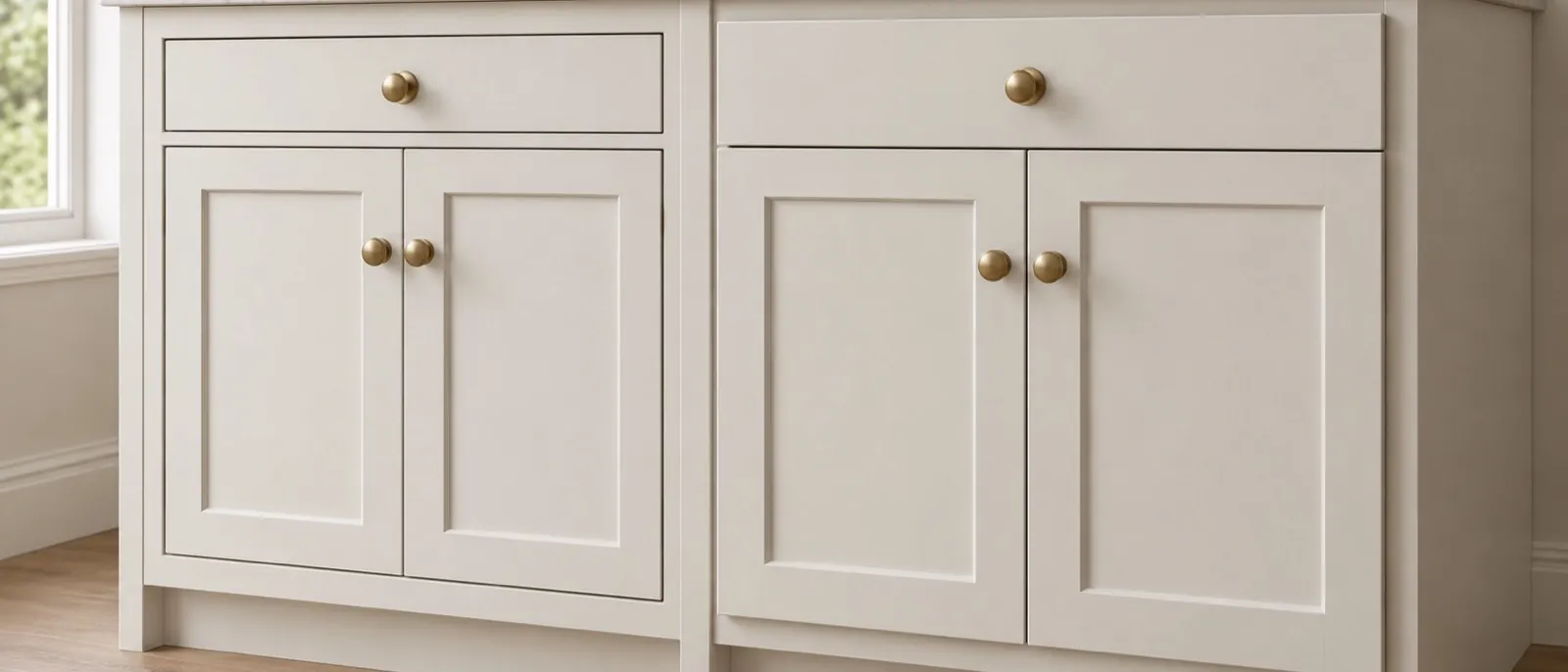
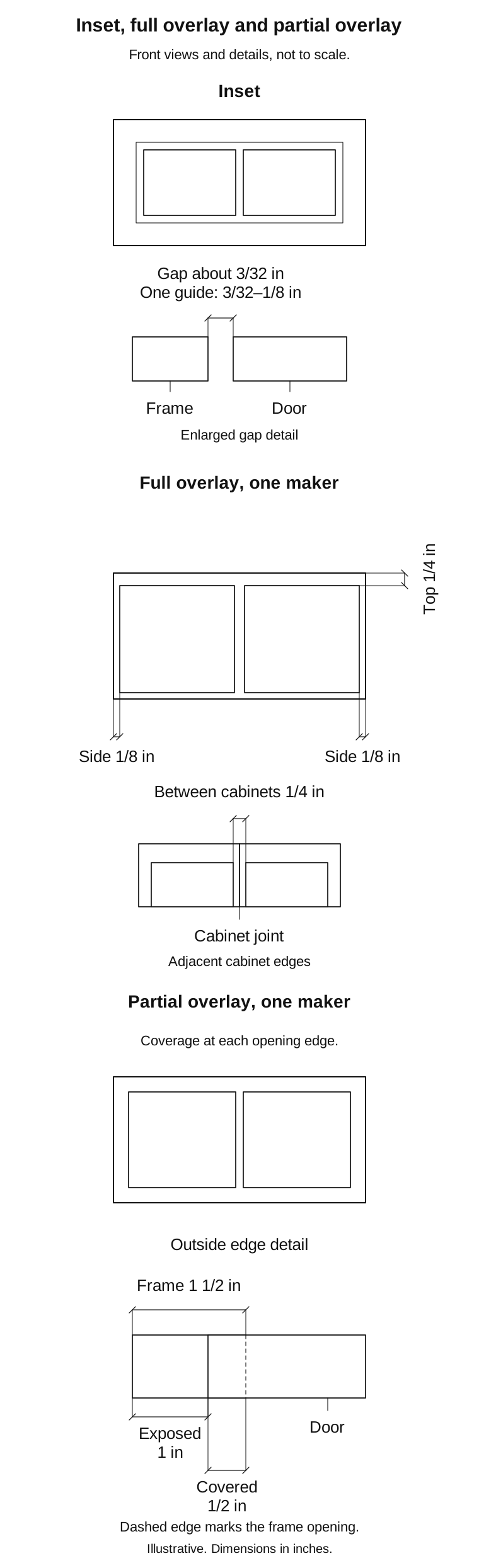
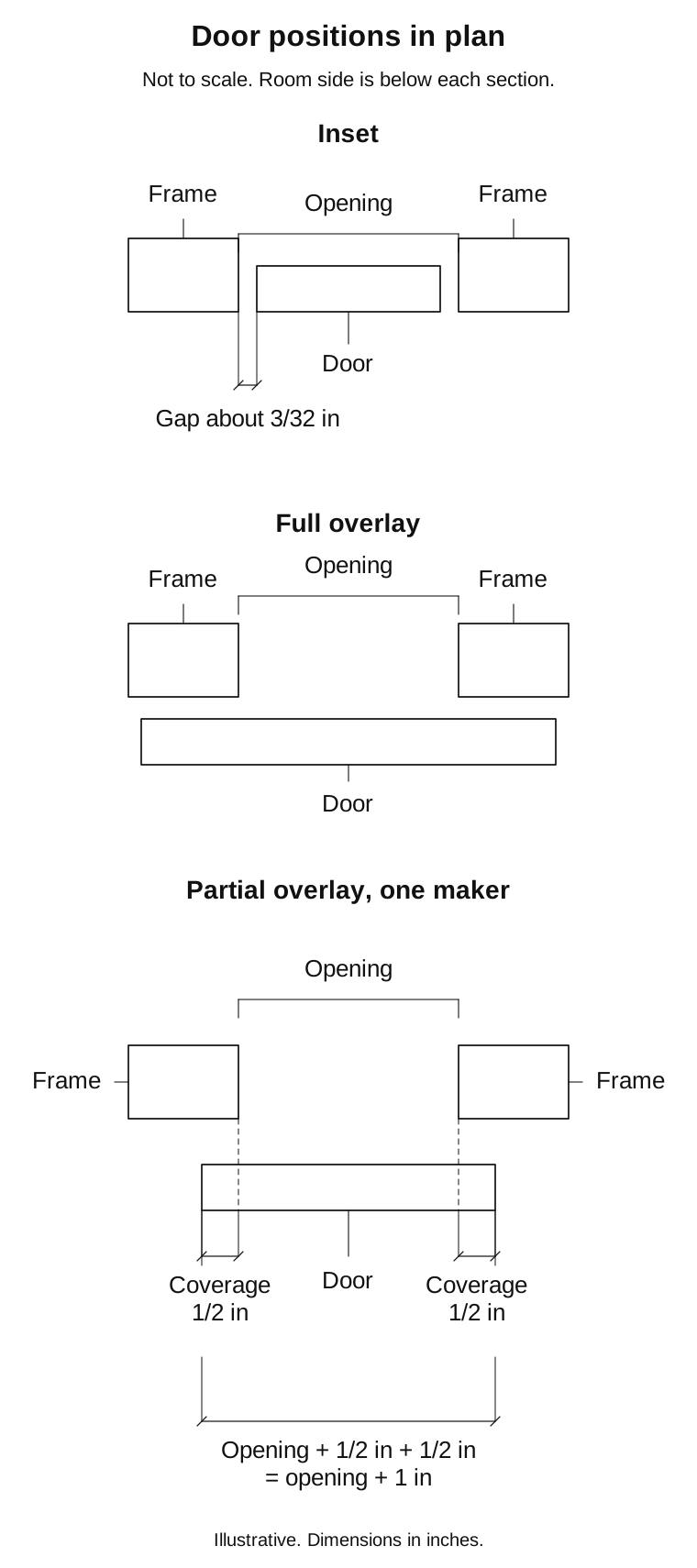
Inset cabinets have doors and drawer fronts inside the face-frame openings, with a gap of about 3/32 inch (3/32 to 1/8 inch in one cabinetmaker's guide).3 7
When you close them, the fronts sit flush with the frame. You can see that frame around every opening.
That narrow clearance takes careful fitting. One maker says changes in humidity can make inset fronts bind.7
Flush inset vs beaded inset
Flush and beaded inset can both use a 3/32–1/8-inch gap; the difference is the frame detail around the opening.3 7
Flush inset has a plain frame edge. Beaded inset has a rounded profile around the opening. Both keep the door inside the frame.
Ask the showroom to point out the door position and the frame detail. Put the sample next to your trim so you can compare the details.
Inset Shaker cabinets
Inset Shaker cabinets pair a flat-panel door with an inset gap of about 3/32 inch (3/32 to 1/8 inch in one cabinetmaker's guide).3 6
Our Shaker cabinet guide covers the door proportions. The Shaker profile and the inset arrangement are 2 separate specifications.
What are overlay cabinets?
Overlay cabinets have fronts ahead of the face frame; one maker uses a 1/8-inch side reveal on its full-overlay cabinets.1 9
An overlay measurement tells you how far a front covers an edge. A reveal is exposed frame. A gap is the space between fronts or between a front and its frame.3
Ask which measurement is on your quote. Those words don't always refer to the same part of the cabinet.
Full overlay cabinets
Full-overlay fronts cover most of the frame; one maker leaves a 1/8-inch reveal at each cabinet side.1 9
Put 2 cabinets next to each other and those side reveals make a 1/4-inch joint: 1/8 + 1/8 = 1/4 inch. The same maker uses a 1/4-inch top reveal.1
Those measurements apply to that maker's construction. Ask for the dimensions from the line on your quote.
Partial overlay cabinets
Partial-overlay fronts cover part of the frame; one maker covers each opening edge by 1/2 inch.1
That maker calls the style marginal overlay. Its front adds 1/2 + 1/2 = 1 inch to an opening dimension.
The same cabinet has a 1 1/2-inch frame. Subtract the 1/2-inch coverage and 1 inch of frame stays visible at an outside edge.1
Full overlay vs partial overlay
Full overlay leaves less frame showing; one maker uses a 1/8-inch side reveal for full overlay and 1/2-inch edge coverage for partial overlay.1 9
Look at the drawings for the cabinets on your quote. That will show you how much frame you'll see across the whole wall.
Where inset wins
Inset gives you flush fronts with a gap that can be about 3/32 inch, plus a visible frame around every opening.3 5
Pick it when you want that exact arrangement. You can use it with a raised-panel door, a recessed-panel door or a slab door.5
You can also choose concealed hinges or visible finial hinges from some makers.7 Cabinetmakers use butt hinges for inset work too.10 Ask to see your hinge on the door sample. Then ask who makes adjustments after installation.
Where overlay wins
Overlay can avoid the 20–30% inset premium listed in one Middle Tennessee builder's 2026 guide.2
If flush fronts aren't important to you, price the overlay version first. Keep the wood, finish, drawers and installation the same when the shop prices the inset option.
One maker also warns that dimensional changes can make inset fronts bind.7 Overlay cabinets still have wood parts, and wood can expand or contract as humidity changes.8 Follow the care instructions for either arrangement.
Ask each shop for its real delivery date. The sources here don't establish a general speed advantage for either choice.
Cost: how much more inset costs
Inset adds 20–30% in one Middle Tennessee builder's 2026 cost guide.2
That's a regional reference. Your cabinetmaker's quote gives you the price for your kitchen.
Ask the shop to separate the door-arrangement change from any change in wood species, finish, hardware or layout. Our custom cabinet cost guide explains quote scope.
You should also compare custom, semi-custom and stock cabinets before you choose a supplier. Ask whether the proposed line offers the inset option you want.
Storage: what to compare before you choose inset or overlay
Inset and overlay fronts can go on the same cabinet box, but one supplier sizes drawer-box depth differently for the two.4 9 Ask the maker for the inside width, inside depth and usable height of each drawer, in inches.
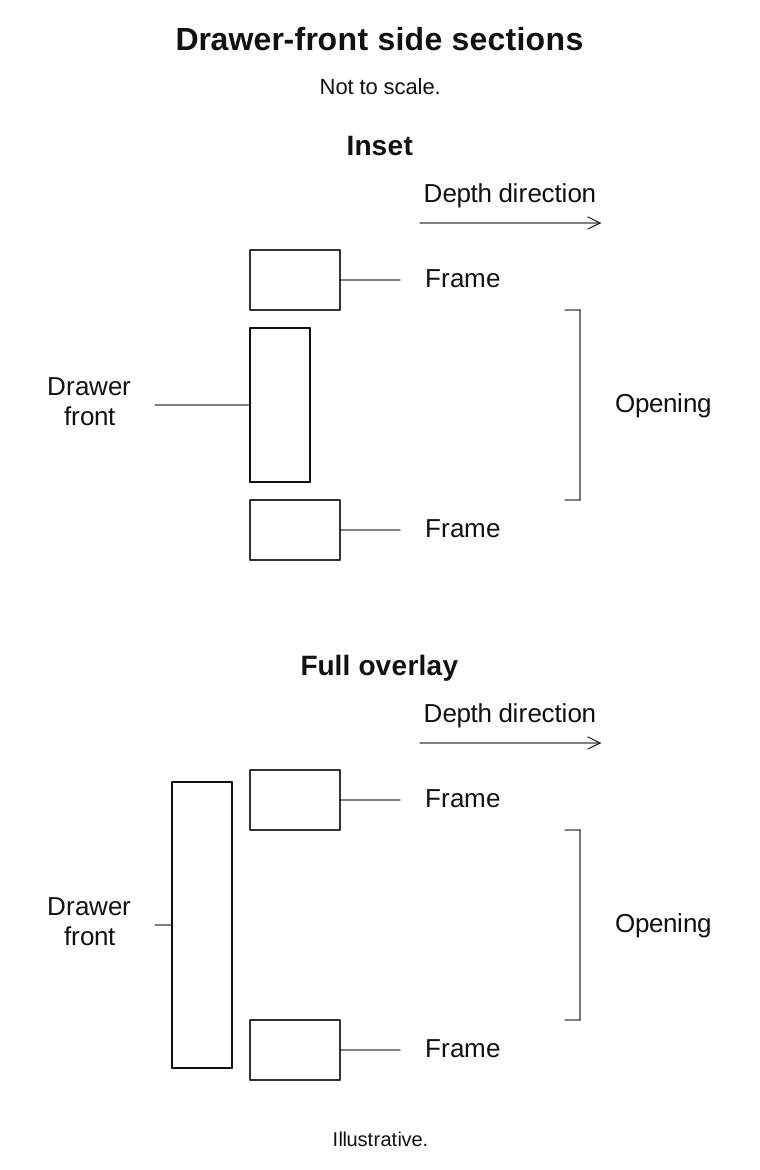
One supplier sizes the finished drawer-box width as the cabinet opening less 3/8 in. for its undermount slide system. Its drawer-box depths follow cabinet depth for overlay face-frame cabinets, and it gives inset depths separately.4
An inset front sits inside the opening. An overlay front sits in front of the frame.5 9 Those definitions don't establish a universal drawer-width loss.
Ask the maker for the usable inside width and depth of the same cabinet in each style. Use our kitchen cabinet dimensions guide for the rest of the layout.
Bring the organizers and cookware you plan to store. Ask the maker to check them against the drawer dimensions on the drawing.
Framed or frameless boxes
Full-overlay fronts are used on 2 box types: framed and frameless cabinets.5
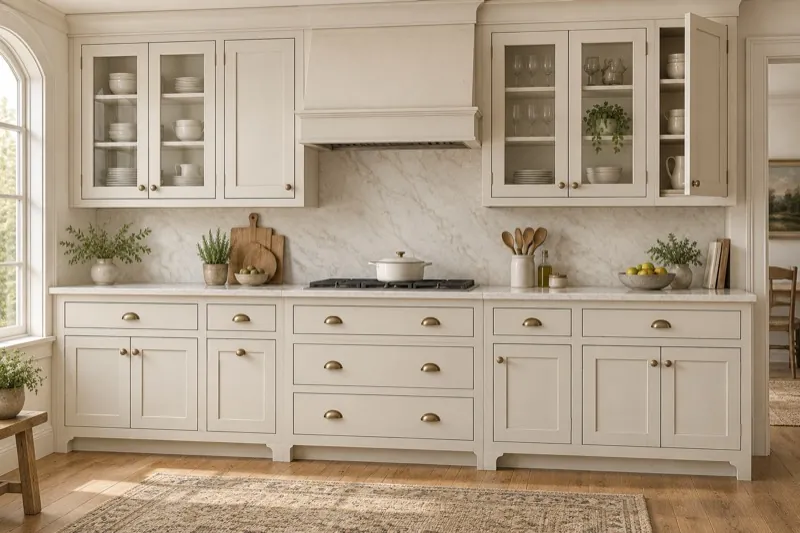
The door position alone doesn't tell you how the box is built. One cabinetmaker's guide also recognizes inset on frameless cabinets, though it says it rarely sees that combination.3
Ask the shop to name the box construction and the door arrangements available in the proposed line.
Which to choose
Compare 3 door arrangements by appearance, quote and cabinet specifications.
- Choose inset if you want flush fronts and visible frames enough to accept the quoted premium and care requirements.
- Choose full overlay if you want most of the frame covered.
- Choose partial overlay if you want more frame showing and the quoted option meets your needs.
Ask about cabinet construction and strength as separate items. Before you approve the order, look at a complete base cabinet with its drawer open.
Check the usable space, hinge appearance and closing action. Ask what happens if a front rubs after installation.
What to ask the cabinetmaker
Ask the cabinetmaker to put 6 details in writing: reveals, drawer dimensions, hinges, materials, finish and adjustment terms.
Start with these questions:
- Which gaps and exposed-frame dimensions will appear on the shop drawings?
- What are the usable inside width and depth of each drawer?
- Which hinges can you see when the doors are closed?
- What material is specified for the door frame and center panel?
- What finish goes on the door faces and edges, and when does final fitting happen?
- What indoor conditions does the maker require, and who handles later adjustments?
Wood movement can change joint lines even when the center panel uses a more stable manufactured material.8 Ask for the care instructions and warranty terms before you choose a finish.
Our questions to ask a cabinetmaker cover the rest of the contract discussion.
Questions people actually ask
What is the difference between inset and overlay cabinets?
Inset fronts fit inside the face frame with a gap of about 3/32 inch (3/32 to 1/8 inch in one cabinetmaker's guide); overlay fronts close in front of the frame.3 5 9 Full overlay covers more frame than partial overlay. Ask for a sample or drawing that shows the arrangement on your quote.
Which is better, inset or overlay cabinets?
Inset is better for flush fronts; overlay can avoid the 20–30% premium in one Middle Tennessee builder's 2026 guide.2 5 9 Full overlay covers more frame, while partial overlay leaves more showing. Compare the actual price, drawer dimensions, hardware and care requirements before you decide.
Are inset cabinets more expensive?
Yes. Inset adds 20–30% in one Middle Tennessee builder's 2026 guide.2 Use that as a scoped reference and ask your shop for a matched quote. The percentage doesn't establish every maker's surcharge.
Are inset cabinets worth it?
Yes, if you want flush fronts and visible frames enough to pay the 20–30% premium in one Middle Tennessee builder's 2026 guide.2 5 That's your value judgment. Compare finished samples and the actual price difference before you decide.
What are the pros and cons of inset cabinets?
Inset gives you flush fronts and a gap of about 3/32 inch (3/32 to 1/8 inch in one cabinetmaker's guide), while dimensional changes can make the fronts bind.3 7 You also need to consider the quoted premium, visible frame and hinge choice. Confirm the maker's materials and care requirements before you order.
What is full overlay?
Full overlay is a cabinet door style that covers most of the face frame; one maker leaves a 1/8-inch reveal at each cabinet side.1 9 The actual reveals depend on the maker. Confirm the dimensions for the cabinet line on your quote.
Are partial overlay cabinets outdated?
Partial overlay is a style choice, and no source here measures whether it's in or out of fashion. One maker's partial-overlay example covers each edge by 1/2 inch and leaves more of the frame showing.1 9 Compare a complete cabinet arrangement with the rest of your room.
Is inset the same as recessed?
No. Inset describes where the door sits, inside the face frame; a recessed panel describes the center panel's position within the door.3 5 6 A recessed-panel door can have an inset or overlay arrangement. Ask which detail the showroom means when it says "recessed."
Where these numbers come from
The 20–30% inset premium comes from one Middle Tennessee builder's 2026 guide; the gap and overlay measurements come from maker specifications.1 2 3
Door-construction and care pages support the definitions and limits. Drawer-sizing guidance tells you what to compare for storage. The maker examples don't replace the specifications for the cabinet line you order.
- Adelphi: Framed Cabinetry
- Spring Hill Design and Woodcraft: Custom Kitchen Cabinets Cost in 2026
- Roy's Wood Products: Overlay, Reveal, & Gap
- Cabinotch: How do you figure Cabinotch drawer box sizing?
- Dura Supreme: What is Inset Cabinetry?
- Dura Supreme: Explore Fresh, New Options with Shaker Style Cabinet Doors
- Showplace: What are Inset Cabinets?
- Showplace: Effects of Humidity on Cabinets
- Dura Supreme: Crestwood Cabinetry
- Woodweb: Cabinet Face Dimensions (April 18, 2006)