Pantry Cabinets: Ideas, Sizes and Real Costs
The standard dimensions, the depth decision that determines whether you ever find the vinegar again, and what a tall pantry actually costs to build.
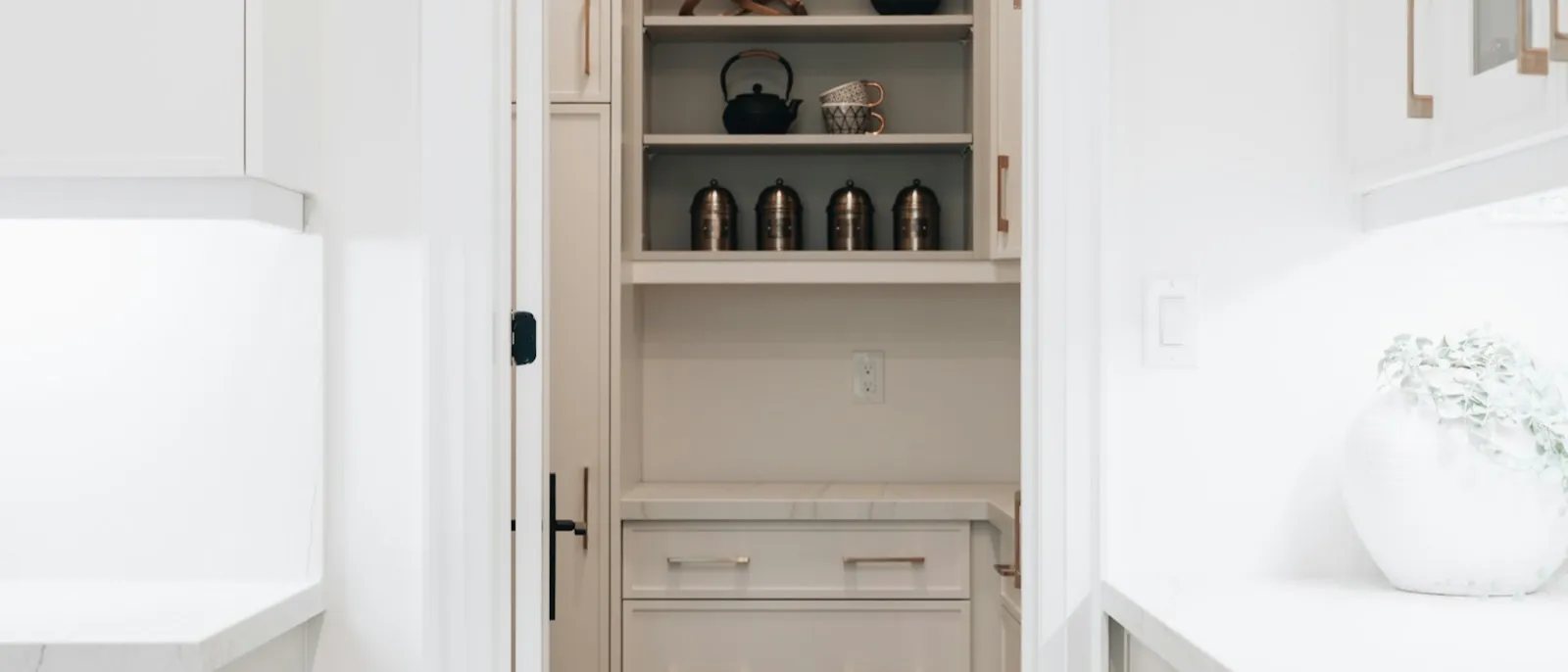
Every pantry problem is the same problem: things go in the back and are never seen again. You buy a second bottle of something you already own. Twice a year you throw out a jar older than the cabinet.
That's a depth problem and a fittings problem, and both get fixed at the drawing stage for a few hundred dollars a cabinet.
The standard sizes
| Dimension | Standard options |
|---|---|
| Height | 84", 90", 93", 96" |
| Width | 15" – 36" (12", 24", 36" most common) |
| Depth | 12", 16", 24" |
Height, by ceiling:
- 84": the default for an 8-foot ceiling. Leaves about 12" of open space above, which reads lighter and collects dust.
- 90": adds one more shelf. The natural fit under a 9-foot ceiling.
- 93": the in-between size, useful when a soffit or bulkhead sets the limit.
- 96": floor to ceiling in an 8-foot room. Maximum storage, no dust gap, and a top shelf that needs a stool.
Anything above about 72 inches needs a stool, so count the top shelf as long-term storage rather than everyday storage when you decide.
The depth decision
Depth decides whether you can find anything.
| 12" deep | 24" deep | |
|---|---|---|
| Capacity | One row of cans, everything visible | Roughly double |
| Findability | Excellent. Nothing hides | Poor without pull-outs |
| Needs rollouts? | No | Effectively yes |
| Best for | Narrow walls, tall runs, everyday staples | Bulk storage, small appliances, big-box shopping |
A 24-inch shelf without pull-outs is two storage zones: the front eight inches you use, and the back sixteen where food goes to expire. Rollout trays convert that dead volume into real storage at $150 to $400 per cabinet.
A 16-inch depth is the underused compromise: more capacity than 12, still shallow enough to see the back row.
Seven pantry configurations that work
1. The 12"-deep floor-to-ceiling wall. A full 96" run at 12" deep along one wall. Everything visible, nothing hidden, no rollouts needed; it holds more than it looks like it holds, because none of the volume is wasted.
2. The 24" tall cabinet with full rollouts. The maximum-capacity answer, with every shelf a drawer. Budget the rollouts from the start rather than adding them later at retrofit prices.
3. Drawers on the bottom, shelves on top. Deep drawers below waist height where you look down into them, adjustable shelves above where you look straight at them. Below waist height a shelf hides its contents and a drawer doesn't.
4. The door-mounted rack. Shallow racks on the inside of the door for spices, oils, and cans, with the cabinet shelves set back to clear them. Roughly free storage, but the hinges have to be specified for the weight.
5. The appliance shelf. One 24"-deep shelf at counter height, with an outlet, so the stand mixer and the food processor live plugged in and slide out for use. Add a lift for the mixer if it lives below counter level.
6. The narrow pull-out. A 9" or 12" full-height pull-out beside the refrigerator. Uses the space that otherwise becomes a filler panel, and holds a startling number of bottles and boxes.
7. The two-zone split. Everyday staples between about 40" and 60" off the floor, bulk and seasonal above and below. Costs nothing at the drawing stage.
What it costs
A manufactured tall pantry cabinet in a common size runs around $1,000. Custom pricing varies with door style, finish, size, organizers, and labor.
For a custom build, the arithmetic is straightforward: a tall pantry is a few linear feet of cabinetry priced at the going rate of $500 to $1,200 per linear foot for full custom, per our cost guide, plus fittings on top:
| Fitting | Cost |
|---|---|
| Rollout trays | $150 – $400 per cabinet |
| Specialty inserts and dividers | $50 – $500 per unit |
| Soft-close hinges | $20 – $50 per door |
| Dovetail drawer boxes | $100 – $300 per drawer |
A pantry is also a good first job to hire a cabinetmaker for. Single pieces can often be slotted into a shop's production line in three to five weeks rather than the six to sixteen a full kitchen requires: a low-risk way to find out whether you want to work with a shop before you hand them the whole room.
Five things to specify
- Adjustable shelves, and how many pin holes. Cereal boxes, stockpots, and wine bottles are three different heights.
- Shelf thickness and span. A 36"-wide shelf in thin material will sag under canned goods within a year. Ask what it's rated for.
- Rollout weight rating and whether slides are full-extension.
- Hinge specification if you're hanging door racks.
- An outlet if any appliance is going to live in there.
If the pantry is going next to a coffee setup, plan them together: a shared alcove is cheaper than two separate builds. Our coffee bar guide covers the clearances that pairing needs.
Questions people actually ask
What are standard pantry cabinet sizes?
Tall pantry cabinets come in standard heights of 84, 90, 93, and 96 inches. Widths typically run 15 to 36 inches, with 12, 24, and 36 inches most common. Depths are 12, 16, or 24 inches. An 84-inch cabinet is the usual pick for an 8-foot ceiling and leaves about a foot of clearance above; 96 inches runs floor to ceiling in the same room.
Should a pantry cabinet be 12 or 24 inches deep?
Twelve inches if you want to see everything you own; 24 inches if you need the volume. A 12-inch shelf holds one row of cans and nothing hides behind anything. A 24-inch shelf holds roughly twice as much and creates a dead zone at the back where food goes to expire. If you choose 24-inch depth, budget for pull-out shelves: otherwise you've bought storage you can't reach.
How much does a pantry cabinet cost?
A tall pantry cabinet in a common size runs around $1,000 as a manufactured unit. Custom pantry cabinets vary widely with door style, finish, size, organizers, and labor. As a rough frame, a custom tall pantry is a few linear feet of cabinetry at $500 to $1,200 per linear foot, plus interior fittings: rollout trays run $150 to $400 per cabinet and specialty inserts $50 to $500 per unit.
Are pull-out pantry shelves worth the cost?
On a 24-inch-deep cabinet, yes: close to mandatory. At that depth the back third of every shelf is unreachable without unloading the front two thirds, and rollouts convert dead volume into usable storage for $150 to $400 per cabinet. On a 12-inch-deep cabinet they're largely unnecessary, because you can already see and reach everything.
How tall should a pantry cabinet be for an 8-foot ceiling?
Either 84 or 96 inches, and the choice is about what you want to look at. An 84-inch cabinet leaves roughly 12 inches of open space above, which reads lighter but collects dust. A 96-inch cabinet runs floor to ceiling, maximizes storage, and eliminates the gap, but the top shelf needs a stool. Ninety and 93 inches are the mid-range options, with 90 working particularly well under a 9-foot ceiling.
Where these numbers come from
Standard heights, widths, and depths from Spring Hill Design & Woodcraft, Creative Closet Organizers, and Kitchen Search's 2026 standard sizes guide; pantry cabinet pricing from CliqStudios; fitting and hardware costs from Casta Cabinetry. Confirm every dimension against your own ceiling height and appliance sizes before ordering.